Thursday, September 23, 2021

Narcissistic Pastoring Part 2 - the making of a slave

Background:

I read it in a comment and I experienced it myself. Dana was a happy, cheerful and devoted RP. Now she has been arrested and charged with Child Endangerment. Her husband Paul has additionally been charged with first-degree rape.

The story that the preliminary charges tell: Paul raped a child and Dana stood by and did nothing to stop it. https://www.examiner.org/belle-center-couple-charged-in-alleged-child-sex-abuse-case/

How do two lifelong [I believe] RPs wind up in such a horrible situation? I believe it falls squarely on the shoulders of narcissistic pastoring and Complementarianism. For Paul, the message was one of entitlement and lack of responsibility, and for Dana, it was sacrifice and culpability.

Let's first talk about male entitlement within comp. theology. Males are in a hierarchical relationship above women. Generally, all males and all females, but more specifically, husbands and wives. The "superior" in a hierarchy is assumed to be superior in all ways (morally, intellectually, spiritually) unless proven otherwise, and the inferior is assumed to be inferior unless proven otherwise. Likewise, the "needs" of the superior trump the "needs" of the inferior.

We can read this in complementarian books all the time. The man's need for respect trumps any desire the woman might have for any of her needs. The man's need for sex trumps any rights the woman has to say no, to heal, to have her own desires. And, when men's needs are not satisfied, the woman is blamed for what results - abuse, neglect, adultery, even incest!

In pure complementarian theology, the last time the woman has a real right to say no is at the altar, and even then there is intense pressure to say yes (because he is superior unless proven otherwise!)

Pursuit:

Pursuit is a common theme in abusive marriages. Women talk about being swept off their feet. No extravagance was spared while dating. He was always there to meet every need, answer every call. The man worships the ground she walks on.

Paul moved to Belle Center, I believe, for the sole purpose of pursuing Dana. It took a long time - at first it was "absolutely not" (I've heard this before, as well), but over time, and with presumably superior pastoral insight from Pastor Phil Pockras, she eventually said "yes".

Even the marriage was a red flag. Apparently, he couldn't wait a couple of months for the wedding they were planning, so they got a few witnesses and Pastor Phil Pockras married them on the spot. I'm not even sure if parents were able to make it.

Pastor-sanctioned abuse:

It would be one thing if Paul whisked Dana away from any oversight (this happens sometimes in Muslim/American marriages where the wife is taken to Saudi Arabia and trapped in their Sharia law). But no! Paul buys a house directly across the street from Pastor Phil Pockras. Paul, a hard-working builder and architect left their house in shambles while he went off to fix other peoples' houses.

It shocked me that they never moved away from Belle Center. He had an architecture job that presumably paid a living wage, but it was far away, so he gave it up (instead of moving away from Pastor Phil Pockras) and chose hourly/day labor jobs that barely paid the bills. According to comments, Dana had to work as well to make ends meet.

Again, my belief is that the constant comp. preaching and demeaning of women/wives that happened at Belle Center trapped Dana in a financially, spiritually and emotionally abusive marriage. Second-hand, I heard that she described abusive things, and when she was asked whether it was okay to be treated that way, well, she probably deserved it. That's the message coming from the pulpit.

Entitled rape:

This is entirely speculation, but it is not unprecedented. In Sovereign Grace Ministries, there's "Taylor's story" where her husband is raping their 10-year-old daughter. The husband is offered grace, while the wife and daughter are blamed for their "part" in the situation. The wife is told not to report the rape to the police, to be available (male entitlement) for her husband and lock their daughter's bedroom.

In the SGM situation, the comp. culture of the church, the leaders and all their friends led her to believe she was doing the best thing by staying silent and respecting her husband's needs.

And, this is the persistent story in complementarianism. The male needs sex. If he is not satisfied, it is primarily the fault of his wife. She needs to lose weight, go to the gym, get some work done, or generally do whatever she can to be attractive enough to satisfy him.

Given that they lived across the street from the pastor, I'm sure she has been the target of shaming because of her "role" in all this.

What's next?

I pray that in their situation, she wakes up. If Pastor Phil Pockras has been supporting this sham of a marriage for 15+ years and probably blaming her for not being submissive and available enough, she needs to divorce him, take the kids and find a better life. There is nothing but shame left in the RPCNA for her.

She did not bring this upon herself. She was repeatedly victimized and abused by those who should have most modeled the freedom and love of Jesus, but instead, she was trapped and abused.

Like SGM and Piper, Pockras will dissociate himself from any wrongdoing as a result of his cultic and toxic teachings and will continue to play the sympathy card.

Yet - it's a catch-22 for him if someone looks carefully enough - If he couldn't provide pastoral oversight to the family living across the street, he's incompetent. If he provided that pastoral oversight, then why is the husband charged with rape and the wife with child endangerment, and the house in shambles? I believe the most accurate picture of Phil Pockras's pastoral legacy is the view across the street.


Sunday, July 25, 2021

Narcissistic pastoring in the RP church - part 1

 
This is a situation that has me so angry. I'm going to start with the most innocuous bit of the whole saga that shows how callous, uncaring and evil this RP pastor is and then start walking though what led to this situation.

Background: RP Pastor Phil Pockras is the pastor of Belle Center OH, RPC (the fact this is in Great Lakes - Gulf Presbytery should come as no shock as the level of narcissism is befitting only those who remain in that presbytery).

Two long-term members of Belle Center were arrested recently, according to https://www.facebook.com/LoganSheriffOhio/posts/4447913998599956

Paul Soma, for 2 Counts Gross Sexual Imposition and his wife, Dana Soma, for Endangering Children

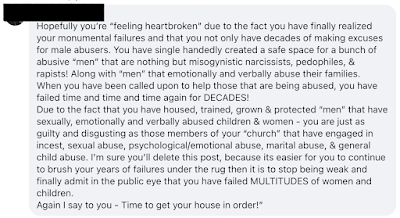
I will talk about the charges in a later post, but look at the response. Their pastor, for decades, Phil Pockras is "feeling heartbroken". Not for any victims, not for the faithful RP wife who obeyed her abusive and allegedly sex predator husband to the point of fleeing from the police with him, but for himself and for his church.

For his church - "Major distress in our church", but note that he is ready to accept pity for himself. Major red flags here. In this situation, you have sexual assault victims, a member of the church accused of sexual violence and another accused of child endangerment and his sadness is primarily for the affect on his church. (And since the pastor is the spiritual equivalent of the church, against, this is all about him.

I'm also fascinated what is behind this response, but I think there will be much more to work through on this one in later part(s).

I don't want to leave you too much in the dark about where I'm going with this. I want to point out that there is a lot of history of Evangelical/Reformed churches creating a safe space for abusive men and how their wives are not only victimized, but gaslighted and spiritually coerced into aiding and abetting criminals.

For example, Katie Sitler, wife of convicted pedophile Stephen Sitler and member of Doug Wilson's church in Moscow ID, was first encouraged to marry him knowing that he was a convicted pedophile, presumably to cure him. After they had children of their own, she allowed him to molest the children, despite being appointed as a court observer [seriously??] to prevent him from doing just that.

One of the reports that came out of Sovereign Grace Ministries was a wife whose husband was molesting their teenage daughter. She was discouraged from going to the police (the elders also failed in their duty as mandatory reporters to report him), and instead they recommended she make herself more sexually available to him and lock the daughter's bedroom door at night. When she was finally fed up enough to be part of a lawsuit against SGM, the statute of limitations had run out.

What I think is heartbreaking is when women and children are gaslighted into a crazy system where they have to choose between their religion (i.e. patriarchal authority and blind submission to whatever the authority says, even if it's wrong) or their morality (I'm sure these women know in their heart that what they are doing is wrong, but every authoritative voice in their life says otherwise).

As the comment suggests, Phil Pockras is not some innocent observer to criminal behavior. He, the GLG Presbytery, and to a lesser extent, the RPCNA, have created an environment where abusers flourish and are protected from scrutiny. Abuse-suffering children are not believed (I can attest to this!). Abuse-suffering wives are not believed, or even if they are believed, they are told that God wants them to suffer for his sake. Both wives and children are taught that God cares more about the "institutions" of marriage and family (meaning patriarchal authority), than he does about the people in those relationships. (It's a bait-and-switch, but that is where they double down)

Edit: It seems pretty obvious what gender matters in Belle Center, evidence for the comment above:


To be clear, many women commented that they were praying for him, too, but I guess they don't count.

Also, I found the charges. The date of the offense is listed as 1/1/2012 for both Paul and Dana. There are no other details, but this is very concerning, given that nine years have passed between the time of the offense and the time that arrests were made.

Friday, July 16, 2021

Twisted Total Depravity, Original Sin and the PCA ruling

As I tried to understand why this PCA ruling bothered me so much, the thing that came back to me over and over again was the concept of original sin. We inherit a sin nature that prevents us from being able to bridge the gap between us and God in our own strength. That sin nature is not a permanent part of our identity, but it remains with us throughout our earthly lives. How God deals with the sin nature varies by each person. As we see with Paul, our "body of death" becomes a consistent struggle during our lives once we are saved.

As I said, on the surface, it seems that the PCA ruling is simply being deliberate and precise when it comes to dealing with our depraved sin nature. They can say that referring to our "body of death" as our identity is theologically incorrect. I get that and I can see where they're coming from. The ruling, however, goes beyond that.

I don't see this precision in the Bible. How can Paul say, "It is a trustworthy statement, deserving full acceptance, that Christ Jesus came into the world to save sinners, among whom I am foremost." (1 Tim 1:15) We Reformed people cheer Paul's honesty and humility here, but what Paul is doing is stating an identity. A few verses before, he says what he was - blasphemer, persecutor and violent aggressor.

I think the basis of the concern is normalizing specific identities. This is concerning because the church has compartmentalized effects of sin that are okay and those that are not. Talking about original sin.

Statements one could make about results of original sin:

I'm blind. PCA would probably accept this statement, even though the blindness is part of the original sin, and presumably the bodies we receive when glorified are not blind.

I have Down Syndrome. Again, okay because it is part of original sin, and a characteristic that has physical basis.

I have ADHD. Okay, we're now starting to get into the gray area as far as Reformed beliefs go. There is pretty good evidence that ADHD is innate, but because it is now a struggle of self-control, which is a spiritual fruit, there might be concern.

I am attracted to ... (non-normal attraction). Again, this could be a result of original sin, but if ADHD is gray, we've now crossed the line. Even though self-control is a spiritual fruit, and thus, lacking self-control would be fairly categorized as sinful, this must clearly be wrong.

The difficulty I have is that all of these are fixed in the resurrection, or through some other miraculous means. They can be managed, they can be accommodated, but we don't have the expectation, in this life, that God is going to remove these burdens from us.

My conclusion, then, is that ADHD and SSA can be innate characteristics, just like blindness or genetic diseases, that are a result of original sin, but the PCA wants to refuse that. They want to deny that innate characteristics can lead us to sin, which is a denial of Total Depravity. Total Depravity says that we are born predisposed to sin. Calling out our sinful predisposition is not a "sin identity", but recognizing our depraved condition under the Fall.

Conversely, when the PCA claims that ordained leadership cannot have a sin identity, they are asking leaders and those who aspire to be leaders to cover up their depravity. They will even refuse to recognize the implications of this. Modesty is moot because no true Christian would have a fleshly struggle with women's bodies (despite the fact that the church calls this a universal male struggle). Sigh.

Tuesday, July 6, 2021

PCA General Assembly rules: Ordained leadership cannot struggle with temptation

In a ruling befitting the Judaizers in Galatians, the PCA ruled the following (wording thanks to https://twitter.com/PCAByFaith/status/1410594510912901123)

16-4 Officers in the Presbyterian Church in America must be above reproach in their walk and Christlike in their character. Those who profess an identity (such as, but not limited to, 'gay Christian,' 'same sex attracted Christian,' 'homosexual Christian,' or like terms) that undermines or contradicts their identity as new creations in Christ, either by denying the sinfulness of fallen desires (such as, but not limited to, same sex attraction), or by denying the reality and hope of progressive sanctification, or by failing to pursue Spirit-empowered victory over their sinful temptations, inclinations, and actions are not qualified for ordained office.

First of all, I'd like to put this up against scripture. Paul says, in Romans 7:

For I know that good does not dwell in me, that is, in my flesh; for the willing is present in me, but the doing of the good is not. For the good that I want, I do not do, but I practice the very evil that I do not want.

We don't know the nature of this sin struggle that Paul is talking about, but we understand that being a Christian, and even being a Pastor/Apostle does not remove temptations. Here we see that some temptations are a result of "our own flesh" versus the sorts of temptations Jesus struggled with that were not due to the coexistence of a sin nature.

So, this is the sort of ruling where the conclusion(?) might resonate with many of the leaders, but the reasoning is essentially denying gospel principles. Are PCA leaders limited to those who have, through God's grace, overcome all of their fleshly temptations? Is it, instead, just a name game where it's okay to struggle with besetting sins, but not okay to "identify" with those besetting sins.

That's honestly what it sounds like, but it is wrapped in anti-gay language. So, play this out. A man wants to become a PCA pastor having had a lifelong struggle with alcoholism. He recognizes that his battle with his flesh means that he needs to abstain from alcohol for the rest of his life, lest he give into the temptation. So, I guess he can say that he struggles with alcohol, or maybe that he is tempted by alcohol, but if he says "I'm an alcoholic" BAM! It's over, no ordination for him! Is that what this is all about - maybe on the surface, but I think it's worse than that.

Let's look at the second aspect. What has the PCA's action been with regard to fleshly struggles?

Tullian Tchividjian was deposed by the PCA for his extramarital affair. At that time, I believe, multiple women had come forward and described his pursuit of them in what can best be described as clergy sex abuse. Yet... the PCA essentially created a restoration team, including Paul Tripp, designed to restore him to ordained leadership. He was approved for a non-ordained leadership position at a nearby PCA church, and his team went on the offensive to recharacterize his sins as relatively minor and forgiven compared to the sins of those around him.

So, in essence, Tchividjian was a clergy sex abuser, but he didn't "identify" as a clergy sex abuser, so he can still be restored, but a pastor who "identifies" as same-sex attracted is disqualified?

There is a third aspect. Temptation is not sin. When studies show that >50% of pastors "struggle with porn", they're not talking about identity or temptation. This means that these pastors are viewing porn. On the other hand, when a pastor talks about same-sex attraction, but remains celibate, he is tempted, yet presumably without sin. The PCA turns this on its head. The porn-addicted pastor is qualified, but the same-sex attracted pastor is disqualified.

This is indicative of a dangerous theology. We, as Christians, become new creatures, yes, and we have the Spirit-given power to resist temptation, but we are not automatically freed from our fleshly tendencies. That is what Paul is saying. We are at war with our own remaining sinful desires, our body of death, as Paul says. The PCA is driving honesty and integrity underground, because denying our sin struggles is the opposite of accountability. Pastors will be afraid to be accountable, lest they find themselves unemployed. The PCA is also perpetuating the authoritarian myth that PASTORS are different than you and me. You see, WE may struggle with our sexual identity, and we may struggle with besetting sins, but the approved pastors do not. They are spiritually shielded from sinful tendencies, and if you dare accuse them, you probably won't last long because they are now in a battle for their lifelong calling and identity as God's anointed.

Monday, May 24, 2021

Jesus and John Wayne

 I got a copy of this book from the local library. I like that the author took the approach of primarily creating a historical document rather than editorializing about the ramifications of the Evangelical push towards Toxic Masculinity (she doesn't even use the term from what I recall).

My takeaways: 

  • The church became enamored with the ruggedly individualistic picture of leadership, courage and strength portrayed by movie heroes, generally, and John Wayne, specifically.
  • Throughout the 20th century, this image became purposefully used and associated with Christianity and specifically Christian manhood and leadership.

  • In the positive sense, the image created this idea that the men of the church should see their primary goal to be the protection of the weak of society, specifically, families and women.
  • In the negative sense, this led to putting men in a specific box (the John Wayne) box, including recharacterizing Jesus's life and actions on earth, and using this as a measure of their spiritual condition. So-called "weak" or "effeminate" men could never be church leaders. Patriarchy is portrayed as a godly and Biblical model.
  • Also in the negative sense, this led to a toxic masculine leadership model. Our godly leaders must be obeyed, never questioned, and rule by iron fist is the model of righteous leadership, not evidence of domineering.
  • Politically, the Evangelical church became coupled to the "hawkish" factions within government. Friends of the military and friends of those who want to use our military to enforce American values (all in the name of protecting the home front).
  • Also, in the negative sense, the positive concept of protection of women and children did not come with a desire to be accountable for protecting women and children. Thus, the hero worship took over and leaders tend to be exonerated of their abuse of women and children, and women and children are expected to sacrifice whatever they might hold dear on the altar of the greater mission.
Overall, it's a good read, well researched and definitely helps understand how the church became politicized.

Wednesday, March 10, 2021

Shame culture and the RPCNA

I recently read a great article about how Southern honor/shame culture has infiltrated Christianity. https://frenchpress.thedispatch.com/p/where-does-the-south-end-and-christianity - titled "Where Does the South End and Christianity Begin? Understanding the role of shame/honor culture in the roots of Christian rage."

The point is that Christianity should be about guilt - a natural feeling that comes about by doing something wrong. Shame on the other hand, is about being something wrong. I have said in the past that the RPCNA twists the doctrine of Total Depravity to trap members into participating in shame culture.

The article has a poignant quote:

In a guilt culture you know you are good or bad by what your conscience feels. In a shame culture you know you are good or bad by what your community says about you, by whether it honors or excludes you. In a guilt culture people sometimes feel they do bad things; in a shame culture social exclusion makes people feel they are bad. 

This is very applicable to the RP church because shame/honor is used as a rod to drive expected behaviors. I want to point out how some comments made on my blog demonstrate how shame culture is used to make in/out black/white divisions. If you're interested in digging deeper, I also want to point out the my regular commenter Chris specifically does NOT engage in the shame behavior, which is, I believe, why we are able to have collegial conversations.

Comment #1:

You sound like a bitter woman, Kathy.

Note that this is loaded with shame. The author, almost certainly a man, is flat out trying to discredit anything I say. First of all, the word bitter has been defined in Evangelicalism as a point of no return. That is, there is no need to treat me as a human because I'm beyond redemption. Secondly, why does the commenter want to point out that I'm a woman? I suspect that this person is steeped in patriarchy, such that woman itself is intended to put me in a lesser category (note to RP women...). Third, calling me Kathy (i.e. Kathy Stegall) is intended to put me in a category of people who have been marginalized and shamed in the RP church. Kathy was, at this point, still a member in good standing in the RP church, so this person is essentially calling me (assuming me to be Kathy) an unrepentant sinner. This person is insubordinate to the RP church.

The other thing of concern... in shame culture, there is typically an IN group - they determine what the community says. In the RP church, that group is typically elders and pastors. So, it's likely, being that this person feels comfortable shaming others on their own authority, that this person is a pastor or elder. This may be another reason why Chris does not choose to shame, or it may play some small part, because Chris is, in my opinion, one of those genuinely kind RP's.

Comment #2:

You rant and condemn the RP, but are not willing to identify yourself. You hide behind the cloak of just1sojourner.

Did I mention that these comments are all uninformed pot shots? Beyond a cursory glance at the site, it should be abundantly clear that I'm not Kathy and I'm not just1sojourner

Again, there's about 1% substance - yes, I choose to be anonymous - and about 99% turn anonymity into some sort of character reference. Keep in mind that we sometimes honor anonymity, for example Silence Dogood and Publius were names used in Colonial times. So, condemning someone for anonymity is an argumentative fallacy, by which they can ignore the substance of the argument by challenging something external to the argument.

Keep in mind that in a shame culture... in and out is determined by the community, so let's say I have friends and/or relatives still in the RP church. Guilt culture would recognize, despite disagreement with me, that my guilt does not fall on my RP connections, but shame culture would use shame to pressure those connections for maintaining their connection to me - someone out of the group. Remember that Jesus was shamed for being "a friend of sinners". That is not guilt culture, but shame culture.

Comment #3:

Kathryn Stegall, the EPC would be a good fit for you. I am sure Mr. Hemphill will put in a good word for you.

Again, this is a subtle shaming. Mr. Hemphill, Kathryn Stegall, and the EPC have apparently been determined to be "out" of the RP circle of true believers, therefore, my being or being associated here is a point of shame.

This brings up an interesting point for you remaining RPs. What does the RPCNA teach about churches that are "in" and "out"? It's really unclear. The NAPARC churches appear to be "in" because there are fraternal relations, but on the other hand, they are "out" because they don't hold to the RP doctrine of exclusive psalmody. At best, they are Christians with an asterisk(*).

There is no reason to actually take time to consider. Here's an example. I've called out specific errors in the Westminster Confession of Faith - primarily that it ignores domineering and abuse by "superiors" - which enables the authoritarian culture we see in WCF churches. The EPC holds to the WCF, which is a significant reason why I would not be interested in the EPC.

The RP church is steeped in shame culture. Your position in the church is based on the community opinion, which is, effectively, the opinion of pastors and elders. In my case, I held a position (women deacons) which was church doctrine, yet my pastor and elders opposed women deacons and used public shaming of me to, I suppose, prevent me from influencing those around me.

Christians should refuse to participate in shame culture. Another good quote in the article about shame culture:

Ancient (and modern) Middle Eastern culture that is the Biblical context, is thoroughly shame-based. But traditional Western (as in European) readings of Scripture are more guilt-based, and have tended to … impose their guilt-based worldview on Scripture. This is why the penal substitution metaphor for the Cross (we’re guilty and deserving of punishment, Jesus takes on our guilt) has so dominated Western theology. Much of the movement of theologians of color, especially from Asian-Americans, has been to recover that original shame-based context and message. So, the Gospel is not just “We’re guilty; Jesus removes our guilt” but “We feel shame—and we have no way to deal with it effectively—but Jesus absorbs our shame.”

If Jesus absorbs our shame, then there is no place for shaming of Christians in the church. We accept each other, as Paul did, as brothers and sisters. We're all "in", unless we act in ways that lead those around us to believe that we are "out", which becomes a matter of church discipline. 


Monday, February 15, 2021

What is JOY and how does the RPCNA destroy it?

I've mentioned before how I believe Reformed/Evangelical legalists equivocate between happiness and joy in a way that destroys people's motivation and self-esteem. I'll briefly revisit that, and then propose a definition of joy that is distinct from happiness and helps put this teaching in perspective.

The sermons on joy seem to go in a definitional circle. First, joy is promoted as an essential of the Christian life [i.e. a legalistic requirement]. If you do not have joy, you cannot be a Christian, because the life of the Christian is a life of joy. Then, joy is juxtaposed with happiness [equivocation part 1] - that is, the non-Christians seek "happiness" [a fleeting emotion], not "joy" [which at this point is some ethereal, non-fleeting emotion and will never be defined] and that is ultimately a worthless endeavor. Examples of joy are given. People are described in terms indistinguishable from happiness. Paul sang in prison, martyrs sang while being burned, people work demeaning jobs with a smile on their faces. Examples are paraded of people who were not brought down by horrible circumstances  The unstated definition of "joy" throughout is "spiritual, deep, non-fleeting happiness". This is then brought full circle by the reiteration that we Christians should experience joy in all circumstances, which as far as we can understand from the sermon equates to, "Christians need to "look and feel happy", no matter the circumstances." Sometimes there is even the claim that God provides harsh circumstances for the Christian to put us face to face with our lack of joy.

The conclusions are that: (1) joy is deep, emotional happiness, exemplified by a happy demeanor. (2) The church has no responsibility to encourage or create joy in us because the way to create joy is to put us face-to-face with our lack of joy. (3) We should not try to avoid or change joyless circumstances, other than find a way to divorce our emotions from our worldly circumstances.

My definition: Joy is an emotional response of being a valued member of a larger group.

I like this definition because it shows how the Reformed church misses it completely.

1) Our joy in Christ. We Reformed Christians are supposed to find joy in our relationship with Christ and God; however, the Reformed church destroys our sense of value. Yes, we are adopted heirs, whatever, but when it comes to value, the church shoves Total Depravity in our faces. Worm Theology is ultimately one that removes our joy by making our relationship with God one that is valueless. Yes, in a sense, we are not worthy. That is true! BUT! In Jesus we are MADE WORTHY! We can claim worth and value through Christ. The church blurs and ignores that message to maintain abusive control.

We should have joy in Christ, because we are a valued part of God's redemptive plan. He loves us and wants to overflow our lives so that our joy can flow into others. While I do believe that God can remove our joy in something that is replacing our joy in him, I don't believe that is a primary method, especially in a church/family system where shame and legalism are present. Imagine the story of The Horse and His Boy, but instead of Shasta, newly discovered son of the king and heir to the throne, being treated like royalty, the king says, I need to treat you like a slave so that you can find your own joy within. NO! He was treated like a slave his entire life, why would the king treat his son like that?

I'm not a fan of John Piper, who I think follows the same approach, but read a Neocalvinist rebuttal of Piper:

Do true believers, who have turned toward God in repentance, and come to Christ in faith, and know the joy of sins forgiven, seek after happiness?  Of course not!  They have been redeemed by the precious blood of Christ, adopted into the family of God, and know God as their heavenly Father; their names are written in the Lamb’s book of life; they are risen with Christ, and they seek those things which are above, for ‘their life is hid with Christ in God’ (Colossians 3.1-4).  Believers are exhorted to ‘put on the new man, which after God is created in righteousness and holiness’ (Ephesians 4.24). The joy of serving the risen Christ is the greatest joy known to man this side of heaven.  True believers do not seek after worldly happiness, for they know the blessings of their heavenly Father.

There is not one hint of value here, only legalistic duty and, quite frankly, the juxtaposition of happiness and joy (Do true believers ... seek after happiness?) suggests that the mere thought of Christians desiring happiness is evil. (Another equivocation, mind you, now happiness and joy are opposites!)

2) Our joy in the Church. The visible church is an organization that seeks to provide a place of growth and service for the individual Christian. The church should demonstrate and represent Christ's love to the world, but also to the individuals. We should receive joy as part of the church to see how God builds up his saints and how our individual gifts contribute and matter to the greater good. It is fundamentally joy destructive for Christians to be treated as unnecessary or unimportant or sideline observers in the church, yet this is a tenet of the Neocalvinist church where the "ministers" do the ministry and the laity obey their leaders and praise them at every opportunity.

This is also why authoritarianism is so tempting in the visible church. People desire joy and see their leaders as being joyful because they are fulfilling their ministerial call, so they want to be leaders themselves. We have a lot of people becoming leaders simply because the church does not value non-leaders. Not only that, but when non-leaders complain about a lack of joy, they are told that their relationship with God should be their source of joy and they are unrighteous to seek joy within the church - an equivocation, and unspeakably evil.

3) Our joy in the family. Our family is our closest bond and common purpose. The church should be encouraging parents to raise their children with joy - meaning that the children are valued, their purposes are valued and that they are an important part of the family mission. Instead, the church teaches a system of emotional and physical abuse where the children are taught that they are worthless and don't matter. Parenting books talk about breaking the will, they talk about the child being constantly at odds with God, they talk about the need to downplay their accomplishments and punish every infraction. Children are taught "I'm third" - God first, others second, me third - a message dripping with worthlessness.

So, why are we surprised that every RP generation is a lost generation. When we are, at every turn, beaten away from a sense of hope and purpose, and it is replaced with reminders of our own worthlessness and inability, it's not surprising that there will be many that will seek hope and purpose outside the RPCNA.