Sunday, January 23, 2022

Someone who gets the RP church...

Source

Hannah Anderson tweeted this a while back and I thought it mirrored my experiences:

A little advice from someone who grew up in religious separatism: In certain spaces & with certain people, the only shared conviction that really matters is who you condemn & separate from.
You can talk yourself blue in the face trying to convince them that you share the same convictions on a question, but the only thing that will satisfy them is whether you condemn the same people they do. 
They *need* you to condemn these folks because they've based their righteousness on certain folks being WRONG & their being RIGHT. If you don't agree to that inherent calculus, it gets very, very personal very, very quickly. That's why it's never enough to share their position on a question if you also see that question as a secondary issue. The whole point is that the issue MUST be a primary-level issue b/c its primacy is what grants moral high ground. 
In this sense, the real divide isn't what you think about a given question. It's the weight you give that question. It's whether that question has become a means of establishing the boundaries of the group. 
So my advice is don't waste your breath trying to defend your credentials. For certain people in certain spaces, they don't really care what you think. They only care about who you condemn.

I remember this coming up specifically at Geneva with fellow students who were OPC. I didn't know the "RPCNA-correct" way to deal with them. On one hand, they were NAPARC, shared pretty much every doctrine we did, yet they did not practice Exclusive Psalmody, which was taught as a critical doctrine. A lens through which all so-called Christians were to be judged. On the other hand, they were kind and respectful people who obviously loved God.

On another note, the flip side of the same coin is that RPs will read a paper. A certain paper on gender identity comes to mind. The theology and doctrine can be laughably poor and inconsistent, but because it condemns the right people, the denomination unanimously passes it.

Sunday, January 16, 2022

objectification (part 2)

In part 1, we see how our worldly culture has pervaded the church and led to objectification [rule and desire]. This becomes the narrative the church proclaims, through worm theology, of our relationship with God.

It's no wonder that Millennials find the church harmful and irrelevant. The church has, at least in the last 100 or so years, proclaimed an objectification gospel that has harmed the sheep. In the last article, I showed that cheerleaders get deluded into thinking that cheering for men on the sidelines is a worthy calling, and this is part-and-parcel of a culture that devalues women societally at the same time it claims to value them.

In the same way, the church devalues members at the same time they claim to be valued. This is done by turning God into the supreme objectifier. I want to be careful about this because the best lies are half truths. YES! It is our chief end to glorify God and enjoy him forever! However, that is not done by grinding ourselves to nothing. I think many verses can be twisted, especially dealing with God being our Lord, master, and we being his slaves and servants. We twist domineering into "servant leadership". But read some verses:

No longer do I call you slaves, for the slave does not know what his master is doing; but I have called you friends, because all things that I have heard from My Father I have made known to you. (John 15:15)
Then she called the name of the Lord who spoke to her, “You are a God who sees me” (Gen 16:13a)
Then He will answer them, ‘Truly I say to you, to the extent that you did not do it for one of the least of these, you did not do it for Me, either.’ (Matt 25:40)

This is just a sampling, but the point is that God isn't a distant taskmaster who thinks nothing of us. God calls us "friends", he pours grace and love into us and desires us to overflow into others. He is compassionate, not because he wants to torch us and Jesus jumps in the way. He doesn't see us as worms. His desire is to convict of us of our guilt so that we can repent and return to his arms. He doesn't want us to be shamed repeatedly and told we are worthless. Before the prodigal son could even say a word, the father was telling the servants to throw a party!

Is that the god of the RP church? I don't think so. I remember a story told by an RP woman. She had a child when she was single. She felt convicted of her sin and went to her session. What did they do? They suspended her because she had to be punished. I wonder if she is RP today or even a Christian. What about the Christian school in the same situation. She chose life instead of abortion, but the father of the child got to walk at graduation and she was forbidden.

Ask yourself? Is the RP church a place where you come each week to be encouraged with the love of God, uplifted and proud to be his beloved child and filled with purpose as you pursue the next step in that friendship? Instead, is the RP church a place where you come each week to be challenged (i.e. reminded over and over of your sins and unworthiness in new and theologically sophisticated ways), to be told God can barely stand to be around you because you are a sinner, and being given more and more things you have to do to "prove" to him that you love him (without which he will be disappointed and offended).

Is our only value to God the things we will do for him? Was the father of the prodigal son welcoming only in anticipation of the extra hand on the farm? Was Jesus's lament over Jerusalem that they weren't working hard enough for him?

The objectification I learned in the RPCNA has continued to be a thorn in my flesh. I didn't learn to value people for who they were. I only learned to value people for what they could provide to my purposes. In the same way, I learned to internalize the objectifying voice I heard from church leaders. My lack of value, my lack of righteousness. That became what I assumed God was telling me, and I have to spend so much time rejecting that inner voice that it is still foreign to thing that he delights in me and sings over me.

God and the church, understanding objectification (part 1)

 I think it's probably time to pull some thoughts together. I talk about the RPCNA being narcissistic and authoritarian. Those are loaded terms, so let me abandon them for this post. Instead, let's go back to Genesis and understand two cultures.

God's "curse" of Eve was that she would desire her husband and he would rule over her. I don't think it's a curse, unlike God explicitly cursing the ground. Instead, I think it is a sad proclamation of what would happen after the fall. I think the conservative church has butchered this because they want to claim that women desire to take the position and authority of their husbands, and the response (some churches say deserved response...) is putting her in her place, i.e. domineering.

I think the core word to describe this is objectification it's the root of many of the ills that have come to the forefront in the church today, although I believe only because God has given a voice to the oppressed. The two lines of light and dark are figured in Cain's line vs. Seth's line. We see Cain's line focus on accomplishments and evil, while Seth's line, less accomplished, but more focused on God.

I'd like to focus on Lamech, not the father of Noah, but the other one. Lamech is notable, Biblically, for inventing polygamy. I wonder if the Bible preserves his wives' names to give them more value than Lamech did. In a good RPCNA sermon I heard, the pastor focused on the word took, in describing Cain's descendants. The point being that those women didn't necessarily have full consent in sharing one man. According to the pastor, took is used again to talk about mighty men (sons of God) taking daughters of men - not some weird angel/human hybrids, but world leaders and authorities amassing women for their own benefit.

This is a vague picture of objectification. These women are not seen. They are merely objects for the enjoyment of men, to be ruled over. I think polygamy is demonstrable evidence of objectification, which is why the church forbids elders from having multiple concurrent wives.

Objectification is primarily the ruling over part, and it's not coupled to authority, but aided by it. So, let's say I look at a rich guy. I think, if I can be this guy's friend, I'll get to live like he does. That's objectification. I don't want to be his friend for companionship, but for what I get. In the same way, I look at a woman, not for companionship, but for what I can get (lust). That's objectification.

What I learned growing up in the RP church was objectifying in that sense. For example, my Sabbath School teacher asked us to write down invitations for five people that we would bring to church. It wasn't about the love we could show, about their value and importance, but essentially, wouldn't it feel good if they came to church?

But, there is another, deeper sense of objectification. This is the desire. I think cheerleading is a challenging sport, but I can't get over the system. The most popular, most talented girls in school are convinced that the most worthy and valuable thing they can do is dance and cheer on the sidelines between football plays. The system works. Scores of girls show up the first day of camp and are whittled down through a grueling process until the squad is set. So, here society objectifies women, and ironically, these women fight over each other to be objectified.

Objectification is the root of worm theology, and we lay Evangelicals are the cheerleaders. See, the church builds up and raises the Lamechs to positions of church authority: those who are noteworthy and strong and accomplished. The rest are told that their calling is to stand on the sidelines and cheer. In fact, we're told that this is representative of our relationship with God - we stand on the sidelines and cheer God's work. So, to a great extent, objectification is not so much a result of the Fall, but something inherent to the structure of Creation. You can find complementarians hedging on this, for example, the CBMW:

As most complementarians understand it, Gen. 3:15-16 informs us that the male/female relationship would now, because of sin, be affected by mutual enmity. In particular, the woman would have a desire to usurp the authority given to man in creation, leading to man, for his part, ruling over woman in what can be either rightfully-corrective or wrongfully-abusive ways.

So, the Fall did not cause objectification and domineering but the inferior trying to supplant the superior. It's therefore okay for the superior (husband, church) to "rightfully correct" the usurpation. And that's why we see women in control of everything by their brilliant manipulation (sigh).

No, what we see is women subjecting themselves continually to the abuse of men and society, and even falling all over themselves to be objects for men - celebrated as SI swimsuit models, or Victoria's Secret underwear models. We see the Hollywood culture of women having sex with powerful men in the hopes of landing a role in a movie. We see corporate culture where women slept with men for promotions. Is this what CBMW means by "usurping"?

No, CBMW, and the broad Evangelical church is furthering the objectification of women and the least in the church through their evil caricatures.

Saturday, December 25, 2021

Great insight from Wade Mullen

 If you haven't read Wade Mullen's book Something's not Right: Decoding the Hidden Tactics of Abuse -- and Freeing Yourself from its Power, it's definitely worth the read. I plan to dig deeper into the book and how it demonstrates some of the abusive tactics in the RPCNA, but for now, I want to highlight some pieces that are sure to come to light as more is revealed in West Lafayette. (It's similar to what I was saying about "country bumpkins")

A common excuse of ability that organizations use is the suggestion that those in positions to respond were not prepared through education and training ... Once an organization assumes the responsibility that comes with being in charge, they assume the obligation to make sure they are adequately equipped to exercise their authority. Insufficient training or lack of foresight is not an acceptable excuse for leaders charged with the duty to protect the organization's members (page 109)

For example, when a mandatory reporter of child abuse fails to report suspected abuse and then claims, "I didn't know what the law was," that excuse can be challenged by saying, "You had an obligation to be familiar with the laws when you accepted the duty to care for children." In this case, the excuse of ability is not legitimate. (page 122)

When I read this, my eyes were completely opened to time after time RP leaders who completely bungled investigations and cases and then either they excused it or the higher courts excused it. The sorts of excuses we see are things like "intricate" "complex" "deceptive", etc., when the truth is that these men have no qualifications and they refuse to learn.

I can't tell you how many times I was in a situation with leadership where I proposed an option, was shut down saying the option was ill-advised, stupid, wrong or whatever, only to find with a couple of searches that I was right in the first place. These men refuse to learn and they use claims of spiritual superiority and giftedness as an excuse to refuse any attempts at correction or the need to gain wisdom. 

For those still in the RP church, there is an extraordinary amount of wisdom about how abusive systems are created and maintained and how people can get sucked into those abusive systems and end up knowingly defending abusers.

[Hit post a bit prematurely] The point that rings clear here that I didn't get earlier is that being an elder or pastor in the RP church or any other church is not just about being a smart, nice guy who cares for people. Those are essentials, yes, but it's also about training and work. Just like a teacher or doctor, the elders need to commit to life long training. They need to commit to deep understanding of policies, why they are in place, and when contradictory truth is uncovered, like spiritual abuse and conflicts of interest, the policies need to be updated so that the sheep are protected. Even the policies, though, do not protect the sheep when the leadership are stuck in an abusive system. They simply ignore them.

Someone pointed out that Immanuel was founded with elders in their mid-20's. Probably nice guys who cared for people, but didn't have the wisdom and discernment to protect the flock from abusive pastors and a seasoned retired abusive pastor/elder.

Monday, December 6, 2021

Sexual abuse coverup at Immanuel RPC

Please read the article and watch the video:

https://www.indystar.com/story/news/2021/12/06/immanuel-reformed-presbytarian-church-child-sexual-abuse-scandal-what-know-west-lafayette-indiana/8800679002/

I heard about this a few weeks ago, but the details were so vague I guessed it was something that happened between high schoolers at a retreat. I learned today that this is much worse and it is much darker.

- The perpetrator was a relative of the pastor, but the pastor did not recuse himself and influenced the investigation

- The elders allowed the perpetrator to continue attending church (potentially with victims) and did not inform the congregation and did not create a safety plan.

- Information was selectively withheld among elders, away from Presbytery reports, and even from deacons.

- When the matter was finally reported to the deacons and the congregation, the tone was "we have this figured out and we've resolved everything"

- The leadership did not cooperate with investigators, and, in the words of a pastor asked to intervene, "the whole thing was a coverup".

According to the deacon who resigned, "I can rebuild relationships and I can make new relationships. I can't give kids their innocence back." and "... it appeared to me pretty quickly to be predatory and serial in nature". Apparently, the session labeled it experimental and hormone-driven.

Presbytery has brought charges against the pastor and all the elders, and this seems like "we're taking care of this, let's trust our leaders and move on", but keep in mind that Pastor Olivetti, from the start, felt that this was something he could hide from Presbytery and cover up. Why did the family of the victims not feel safe in going to Presbytery, or even worse, did the Session refuse to transfer appeals to Presbytery? Remember that the RPCNA authoritarian practice requires members to GO THROUGH THEIR SESSION when appealing to Presbytery. If the families appealed directly to Presbytery, their complaints could have been considered out-of-order and rejected.

Jesus and John Wayne meets Jesus

I've found so many parallels between modern Evangelicalism and the Pharisees. Here's another:

In Jesus and John Wayne, John Wayne is the archetype of Christian masculinity and leadership: warlike, strong, opinionated, violent, abusive, powerful, rich. The "sheep dog" of the wolf, sheep, sheep dog analogy, whose penchant for violence must be tolerated in the name of safety and protection from wolves.

What did Jesus say about this?

And from the days of John the Baptist until now the kingdom of heaven has been treated violently, and violent men take it by force. (Matt 11:12)

At that time the disciples came to Jesus and said, “Who then is greatest in the kingdom of heaven?” And He called a child to Himself and set him among them, and said, “Truly I say to you, unless you change and become like children, you will not enter the kingdom of heaven. So whoever will humble himself like this child, he is the greatest in the kingdom of heaven. (Matt 18: 1-4)

And Jesus said to His disciples, “Truly I say to you, it will be hard for a rich person to enter the kingdom of heaven. (Matt. 19:24)

But Jesus called them to Himself and said, “You know that the rulers of the Gentiles domineer over them, and those in high position exercise authority over them. It is not this way among you, but whoever wants to become prominent among you shall be your servant, and whoever desires to be first among you shall be your slave; just as the Son of Man did not come to be served, but to serve, and to give His life as a ransom for many.” (Matt. 20: 25-28)

The Pharisees were also mini-John Waynes looking for a John Wayne messiah to physically overthrow and remove the Roman empire. They anticipated a strong earthly ruler who would come. Instead they got a lamb. A man who took a beating, then wasn't physically strong enough to carry his own cross.

When the actual Messiah came in their midst, he was unrecognizable to them because he didn't fit the shoes they expected him to fill, and because of that, they strongly rejected him. Isn't that what we see today? Wholesale rejection of the Holy Spirit's work in the church because violence and abuse is the proxy for righteousness, not humility and child-like faith.

I think the image I have for humility and servant-leadership in the church today is a ruler who walks down the street quiet and unadorned, but who has hired a dozen people to walk in front proclaiming how humble he is and beat any who dare say differently.

It seems that revival after revival, there is just some new excuse uncovered to justify abusive leadership.

Sunday, December 5, 2021

Patriarchy shows its true colors in Federal court

 In Jesus and John Wayne, Kristin Du Mez explains the philosophical underpinning of what is modern Christian masculinity. Men need to be strong and violent so that they can protect women from all danger. We need soldiers to protect women and children. We need male leaders in government to be vigilant and strong to protect from unholy influences. We need strong male leaders in church to protect the weak and feeble-minded. We need strong fathers to protect wives and especially daughters from harm.

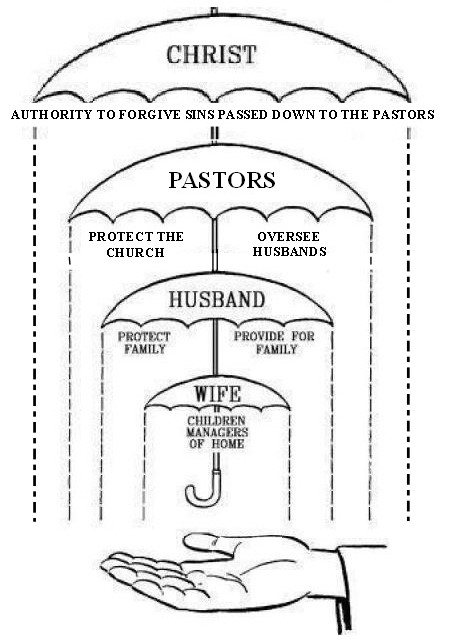
Bill Gothard used a diagram to explain this: 

The idea is that each umbrella is both subordinate to the higher umbrella and under its protection. Thus children enjoy the protection of Christ, Pastors, Fathers and Mothers.

The statement that the Patriarchal system says to women is "we need to be big and strong and manly and you need to trust us as your God-given protectors." This is proclaimed as the fundamental structure for society, and women who walk away from the male-dominated system are opening themselves to evil and a lack of protection.

Jim Duggar is a known follower of Bill Gothard and a poster-child for adherence to the patriarchal system. His wife and daughters were taught that he would protect them and fight for justice from anyone who would treat them unjustly.

Jim's son Josh Duggar is on trial for possession of child pornography. In a pre-trial hearing, defense attorneys were trying to throw out testimony about his history of child molestation, saying it was irrelevant. Duggar family friend Bobye Holt testified that Josh had confessed to molesting at least four girls. Link

Trial Patriarchal hypocrisy #1 - women are pastors. The defense attorneys argued that Josh's confession to Bobye (a woman) was a confession to a "religious figure". In Patriarchal systems, women have no religious authority, and thus his confession to her would not in any way be considered "clergy privilege" by their religious system. So it is hypocritical for Josh Duggar to support a false premise that he confessed to her as a pastor. The judge easily saw through the lies and ruled she could testify.


Trial Patriarchal flaw #2 - lies and lapses to protect fellow patriarchs. *IF* patriarchy is a system where innocent girls can trust their fathers to provide justice for them, how does Jim Duggar's testimony demonstrate this? It doesn't. He "couldn't remember" specifics about what was confessed to him, and he was angry when the police report documenting their investigation was shown in court. Jim was under oath and even more pertinent was a Patriarchal authority with the responsibility to protect his daughters and provide justice for them. "The Court found Mr. Duggar's selective lapse in memory to be not credible; he was obviously reluctant to testify against his son," [Judge] Brooks wrote. The patriarchal system is for the protection of the patriarchs. Jim went on the stand to protect his molesting, adulterous, child porn viewing son, while simultaneously minimizing the wrong done to his own daughters. The rumors are that Jim is using financial abuse to control the narrative and scare/shame the Duggar daughters/daughters-in-law from testifying against Josh. Source

Patriarchal flaw #3 - silencing the victims they are supposed to protect. This leads to a new understanding of the coverup. Jim minimized what Josh had done to his sisters (#2). Bobye Holt's testimony was that Josh confessed far worse molestation at 15 years old than "touching girls breasts through covers while they were asleep" - as Jim claimed. Instead he was touching them while awake, under their clothes. That means that Jim was first lying about what happened, and then he was using his patriarchal authority to silence the victims. They knew what happened, but the protection of the Duggar Patriarchy and patriarch Jim's image was more important than protecting the girls. Understand that? The system that says "daughters, trust us to protect you and bring you justice" was the system that shamed those girls into silence to protect the patriarchs. Patriarchy is just baptized rape culture. Society does enough shaming of victims of molestation and abuse, but here is a system where fathers have to shame their own daughters to pretend that they are holy (and try to keep the TV money coming in, of course).